OAN is designed to grow as open trust infrastructure for the agent-resource ecosystem. That does not mean every participant must run every node on day one. A builder can publish one Skill. A developer can add SDK verification to an application. An enterprise can consume OAN evidence inside existing controls. A research group can evaluate semantic Discovery. A domain community can later operate a scoped Registrar or Discovery node.
Adoption is staged. That is a strength. It lets OAN start with official services and public documentation while leaving room for third-party nodes, specialized domains, enterprise deployments, standards work, and research.
This staged adoption model matches how real infrastructure grows. A trust network cannot wait until every operator, SDK, adapter, standard, and resource category is perfect. It needs a path where early users can publish and discover resources now, while deeper governance, third-party operation, and standards alignment mature around working evidence.
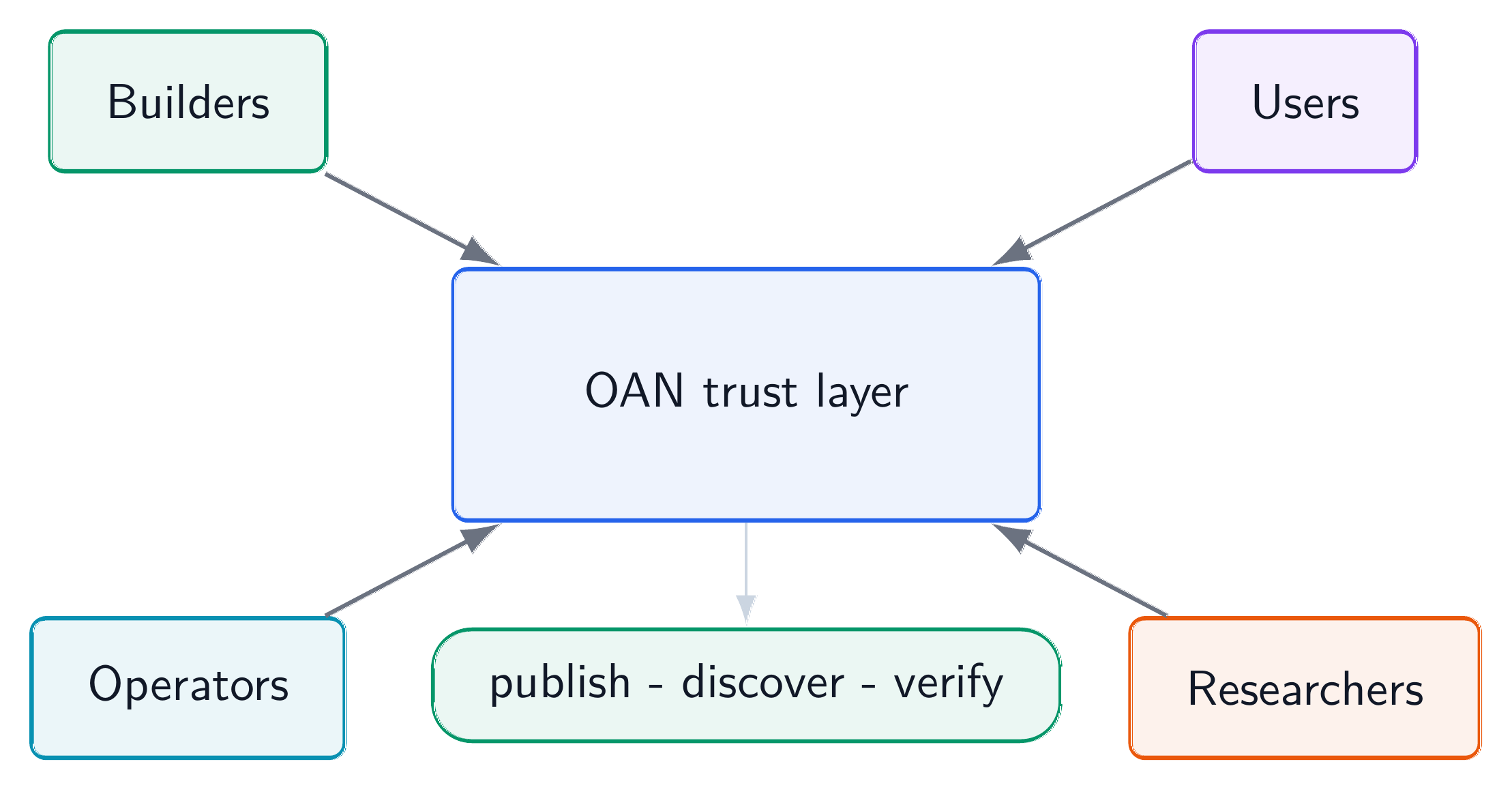
Who Can Participate
| Participant | First useful step | Longer path |
|---|---|---|
| Product builder | Register one real resource with accurate metadata. | Integrate SDK verification and publish updates. |
| Enterprise | Inspect OAN evidence for discovered resources. | Add OAN checks to governance, gateways, or procurement. |
| Node operator | Study trial-network requirements and domain scope. | Apply to operate Registrar or Discovery infrastructure. |
| Researcher | Review papers, slides, and semantic Discovery direction. | Evaluate trust, discovery, governance, or standards models. |
| Community contributor | Improve examples, Docs, SDK use, or skill workflows. | Build adoption tooling and resource profiles. |
The ecosystem needs all of these roles. A trust network with no resources is empty. A resource network with no verification is weak. A governance model with no operators is theoretical. A research story with no implementation is hard to evaluate.
OAN’s advantage is that these roles reinforce each other. Builders create useful resources. Discovery makes them findable. SDKs make evidence usable. Operators expand capacity and domain coverage. Researchers test the model and improve retrieval. Standards work gives external reviewers a vocabulary for discussing the system.
Start with Official Services
Official services give the ecosystem a reference path. Users can register and discover resources without first deploying the full stack. SDKs and community skills can default to the official baseUrl. Docs can explain what happens behind the scenes.
This default path is not meant to create permanent lock-in. It is meant to lower the first step. Once users understand the model, third-party compatible nodes can expose their own baseUrl or endpoints.
The official path also provides a reference behavior for third-party implementers. If a third-party Registrar or Discovery node behaves differently, users should be able to tell whether the difference comes from domain scope, policy, ranking, lifecycle state, or an implementation problem.
Grow into Third-Party Participation
Third-party participation becomes useful when communities need specialized review, local operations, enterprise control, domain-specific Discovery, or additional public capacity. OAN’s node authorization and domain scope model exists to make that participation governed rather than arbitrary.
A future ecosystem can contain official nodes, recognized third-party nodes, enterprise-private nodes, research deployments, and domain-specific nodes. The common requirement is that the trust path remains verifiable.
That future should not require everyone to share one business model. A public Discovery node, a private enterprise Discovery node, and a research testbed can coexist if they preserve the same basic evidence semantics. OAN is most valuable when it lets heterogeneous operators cooperate without pretending they are one platform.
Adoption Surfaces
Public adoption is supported by:
- official website pages;
- Docs markdown packages;
- TypeScript SDK;
- community skill;
- resource registration and discovery guide;
- public examples;
- trial-network material;
- papers and standards drafts;
- slides and diagrams for explanation.
Private official operations, pressure testing, chain upgrades, server credentials, and deployment runbooks should remain separate. Public Docs should explain how to use and join OAN, not expose official operational control.
This separation is also healthy for contributors. Community members can improve examples, SDKs, Docs, resource metadata, and adoption skills without needing private deployment authority. Official operators can keep sensitive governance and server operations in controlled channels.
What Mature Adoption Looks Like
A more mature OAN ecosystem would have many resource publishers, reliable SDKs, high-quality community skills, domain-aware Discovery nodes, clear node-application processes, public status surfaces, and research-backed semantic retrieval. It would also have enough standards-facing material for external reviewers to understand the model without reading private design documents.
The first step is smaller: publish, discover, verify, and improve the examples.
The strongest adoption signal is not a slogan. It is a loop that real users can repeat: publish a resource, find it through Discovery, verify the evidence, use the native protocol, update the resource, and see lifecycle behave correctly.