Agent ecosystems are becoming more open, more distributed, and more automated. That is good for innovation, but it creates a trust problem. A user or agent may find a resource that appears relevant, but relevance is not enough. Before invoking a tool, installing a skill, connecting to an MCP server, or delegating work to an agent service, the relying party needs to know whether the candidate is authentic, current, authorized, and verifiable.
The OAN slide deck calls this the gap between “I found an agent resource” and “I can safely use it.” OAN is built for that gap.
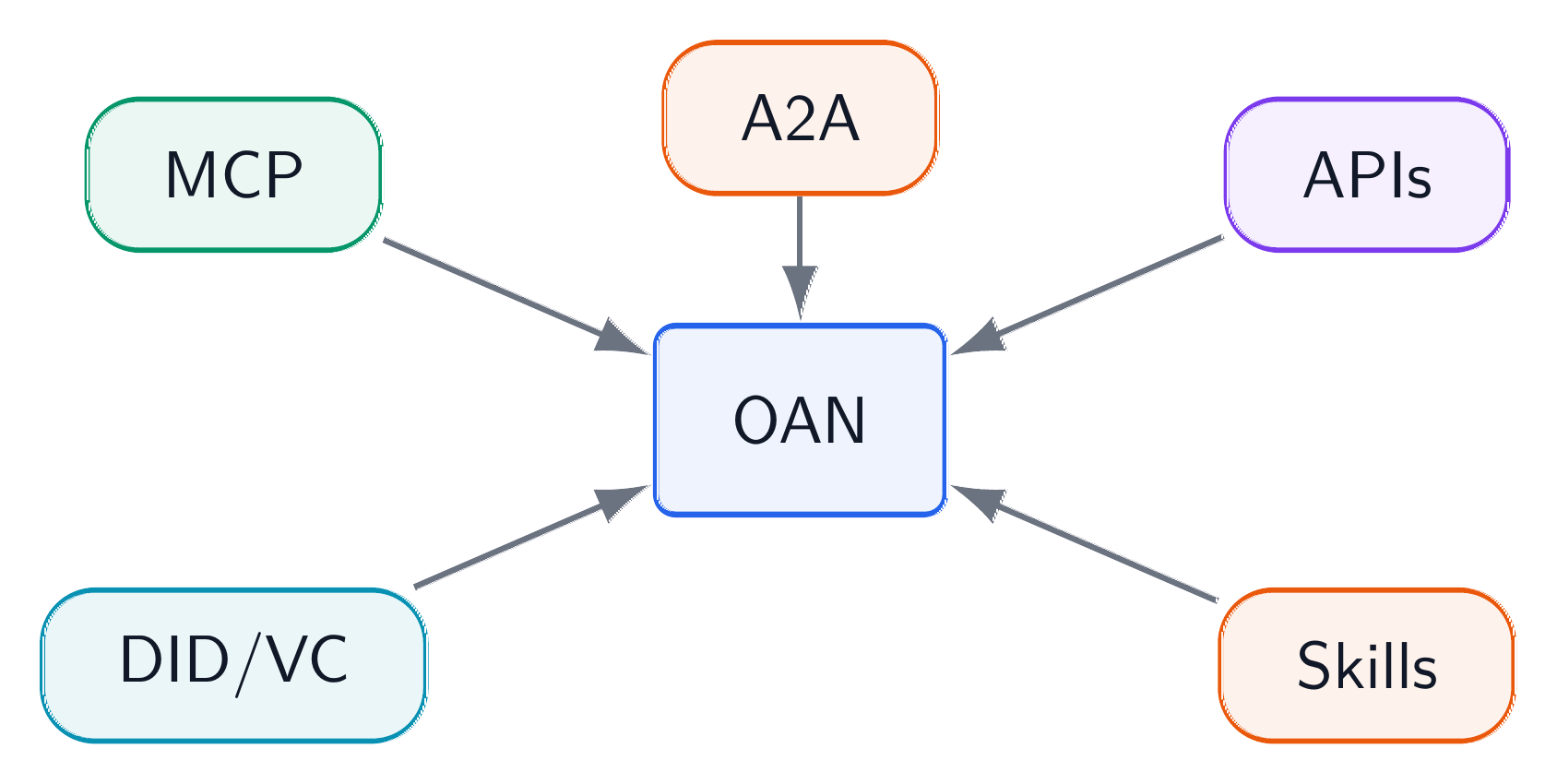
Discovery Is Not Trust
A search result can answer “what matches my query?” It does not necessarily answer “who controls this resource?”, “was this version accepted by a trusted path?”, “is this resource still active?”, or “is this Discovery node authorized to expose this domain?”
This distinction becomes critical for agent systems because agents can act on results quickly. A human may pause before installing a package or calling an unfamiliar service. An automated workflow may call a result immediately if the integration treats Discovery as permission.
OAN separates matching from trust. Discovery can help find candidates, but candidates need evidence before use.
The Trust Gap in Everyday Terms
Imagine a developer looking for a contract-analysis skill. They find a repository with a manifest and good documentation. The repository may be legitimate, but the developer still has questions:
- Is the skill controlled by the stated publisher?
- Is this the latest accepted version?
- Was it registered through an authorized Registrar?
- Does it belong to the legal domain it claims?
- Has it been revoked or replaced?
- Does the package hash match what was accepted?
- Can another agent verify the same evidence automatically?
Without a shared trust layer, each of these checks becomes ad hoc. OAN’s purpose is to make them part of the resource publication and Discovery path.
Why Agents Raise the Stakes
Agent systems often chain decisions. A user agent may discover a resource, fetch metadata, call a tool, pass context, receive output, and use that output in a larger plan. If the first candidate is fake, stale, or out of scope, the mistake can propagate.
This is different from browsing a static directory. Agent workflows may expose sensitive data, trigger API calls, install artifacts, or delegate authority. Trust evidence has to be machine-readable enough for SDKs and agents to check, not merely human-readable enough for a README.
The Failure Modes Are Ecosystem-Level
The most serious failures are not only individual bad calls. They are ecosystem habits that scale badly: installing skills from unverified sources, routing agents to stale endpoints, letting search scores substitute for authorization, copying API descriptions without package proof, or treating a once-approved node as trusted forever. Once these habits spread, every application has to rebuild its own trust rules.
OAN tries to move those checks into a shared pre-connection layer. It does not remove all risk, but it changes the default posture from “connect first, investigate later” to “verify first, then invoke through the native protocol.” For autonomous workflows, that shift is not cosmetic. It is the difference between a tool ecosystem and a trustable infrastructure ecosystem.
Trust Has To Be Machine-Checkable
Human-readable reputation is useful, but agents and SDKs need structured evidence. A result card saying “verified” is not enough unless software can inspect what was verified. OAN therefore emphasizes DID material, package hashes, Root proof, lifecycle, Discovery response provenance, and authorized domains as typed artifacts that can be checked repeatedly.
This is also why OAN’s trust model is layered. If verification is machine-checkable, different clients can adopt different assurance levels without inventing new vocabulary. A website can show the simplified view, an SDK can run strict checks, and an enterprise gateway can add local policy on top.
OAN’s Trust Layers
OAN addresses the trust gap through multiple layers:
did:oanidentity describes the resource subject and verification material.- Registrar onboarding checks the resource submission path.
- Governance defines which infrastructure nodes are currently authorized.
- Root verifies and accepts package versions.
- CDN distributes Root-verified material without becoming the trust authority.
- Discovery indexes only verified, in-scope packages and returns evidence-carrying candidates.
- Clients verify proof, hashes, lifecycle, and endpoint binding before invocation.
No single layer replaces the others. A valid DID does not prove Root acceptance. A Discovery result does not prove native runtime safety. A package URL does not prove integrity unless hashes and proof are checked.
What OAN Protects, and What It Does Not
OAN strengthens pre-connection trust. It helps relying parties verify identity, lifecycle, authorized-domain scope, Root acceptance, package integrity, and Discovery provenance.
It does not guarantee that a resource is high quality, legally suitable, free from vulnerabilities, or safe for every business context. It does not replace API authentication, model evaluation, endpoint sandboxing, enterprise risk review, or domain-specific compliance. Those checks still matter.
The value of OAN is that those later checks can start from a better foundation: the candidate resource is no longer just a URL or search result; it is a verifiable resource with an evidence chain.
Practical Rule
When working with OAN, use this rule:
Treat every discovered resource as a candidate until the evidence passes.
For a user, that means inspecting proof before use. For a builder, it means publishing enough metadata and hashes for another party to verify. For an SDK, it means making verification a normal part of client behavior. For a Discovery operator, it means preserving authorization and package checks before ranking.
Further Reading and Downloads
- OAN white paper on arXiv - motivation and ecosystem positioning.
- OAN English slide deck - slide narrative for the trust gap and OAN trust stack.